





A multi-cloud rollout, de-risked
“Elements.cloud was instrumental in helping Bosch accelerate their Salesforce rollout while reducing risk across a complex multi-cloud programme.”
One metadata graph database holding every component, relationship and process in your Salesforce Org. Kept current as the Org changes. Plus a decade of architect method, encoded so your people and your agents stop guessing.
A walkthrough against a connected Org rather than a scripted tour. Bring the change you have been avoiding and we will point it at that.
Book a demo✦✦


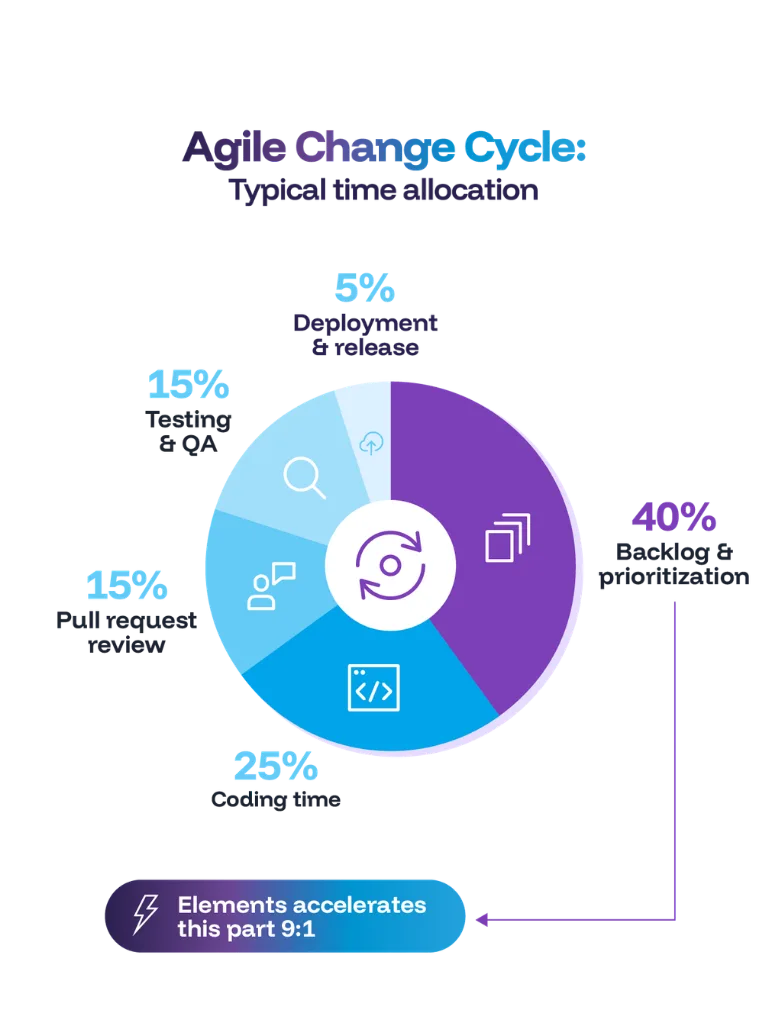
Backlog grooming, impact assessment and defining requirements. Forty per cent of the cycle spent working out what the Org already is, before anyone builds anything.
That work is now being handed to AI, which does it the only way it can: by reading. Same job, same cost, it just moves from hours into tokens.

Per story. Nine hours of discovery for every hour of building, on tracing dependencies and writing a requirement that survives the Org.
For one question. Told to be certain, an agent reads 1,932 automation components. Elements resolved the answer when the metadata was parsed.
Both numbers come from the same place: nothing had worked out how the Org fits together, so everyone starts again. See how both are measured
Every week, Salesforce leaders tell us some version of these three. They are not separate problems, they are the same problem wearing different clothes, and they are what every project actually trips on.
Change is time consuming, risky and exhausting to deliver.
Every proposed change raises the same question: what will this break? You can answer it. It just takes days of clicking, tracing and asking around, and at the end you still are not certain you found everything. Elements resolves what connects to what rather than inferring it.
The Org was not designed. It grew.
Years of mergers, acquisitions and quick fixes leave an Org nobody fully understands. When Elements scopes a requirement it surfaces what is redundant, what is risky and what can be reused, so the Org gets cleaner every time work gets done.
You rediscover the Org from scratch on every project.
Either it does not exist, or it describes an Org that has moved on since it was written. So every project and every change starts with the same discovery work. Elements keeps a living model that updates as the Org does, so the answer is already there when the next project lands.
Every one of these is a project that stalls for the same reason. They are what becomes possible once the foundation is right.
Not sure which of these you are? Book a demo and we will work it out with you.
Time saved is the easiest thing in the world to claim, so here are named people at named companies saying what changed, and by how much.
“Elements.cloud was instrumental in helping Bosch accelerate their Salesforce rollout while reducing risk across a complex multi-cloud programme.”
“Just using this tool alone saves us hundreds of thousands of dollars. And I spend 50% less time figuring out what is going on.”
“Elements saved the day. I spent under an hour on it and knew exactly where the problem was coming from.”
Three questions your security team will ask first, answered before they ask them.
Elements does not update anything in your Salesforce Org. Every skill and every playbook reads.
We sync metadata, not records. Your customer data never leaves Salesforce, so there is no PII held in Elements.
Independently certified against both standards.