

Why metadata and process context are the missing link between agent intent and agent action, and why Elements.cloud is the only tool built to bridge that gap.
Agents are Brilliant Goldfish
AI agents are extraordinarily capable. They reason, synthesise, take action, and work at a speed and scale no human team can match. But they have a fundamental limitation: no persistent memory between sessions. Every conversation, every task, every agent run starts from scratch. That’s why context engineering (deliberately designing and supplying the background knowledge an agent needs to operate effectively) has become the defining skill for enterprise AI deployments.
Here’s the problem: most organisations are engineering context at the wrong layer. They focus on the data. “Give the agent access to the CRM. Connect it to the ERP. Feed it the customer record.” And yes, transactional data matters. But data without context is just noise. An agent staring at your Salesforce Org without understanding what the fields mean, which ones are actually used, how the processes work, and what the business is trying to achieve is like a brilliant new hire who was given a laptop, access to every system, and no onboarding whatsoever.
That’s where most enterprise agent deployments are right now. And it’s why they’re underperforming.
The Four Layers of Context. And Where the Gap Actually Is
Effective context engineering requires four layers, not one.
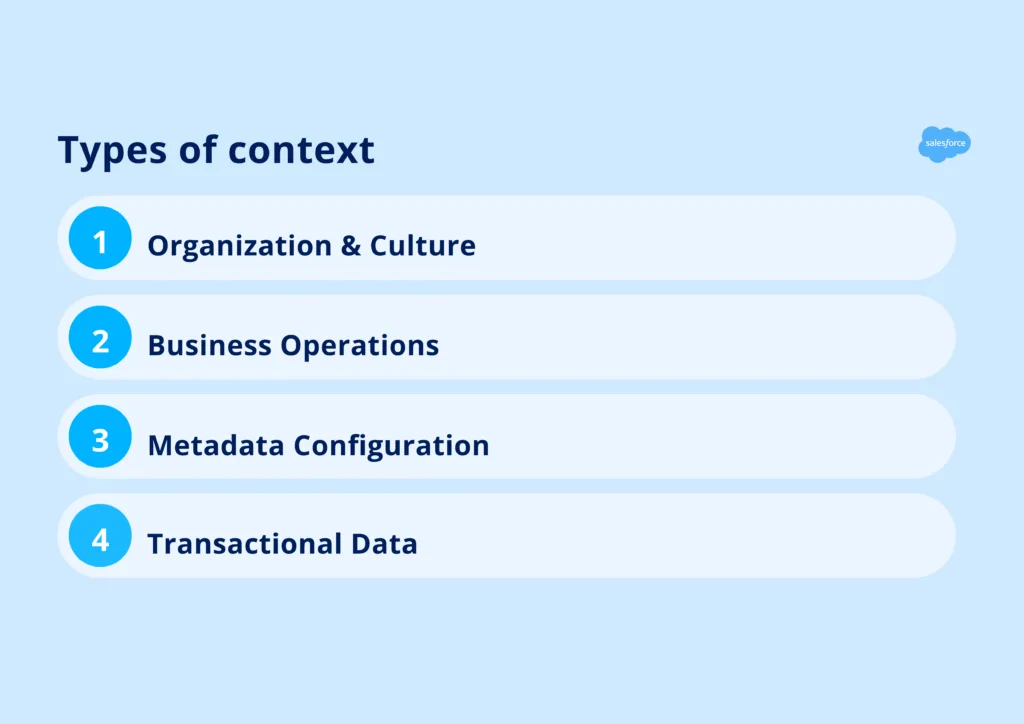
Layer 1: Organisation & Culture is the highest and hardest layer. The values, the risk appetite, and the unwritten rules that determine whether decisions are made in a way that’s genuinely aligned to your business.
Layer 2: Business Operations is the process layer. How does the business actually work? What are the standard operating procedures? What decision logic drives each step? Which process applies to which type of case, customer, or transaction?
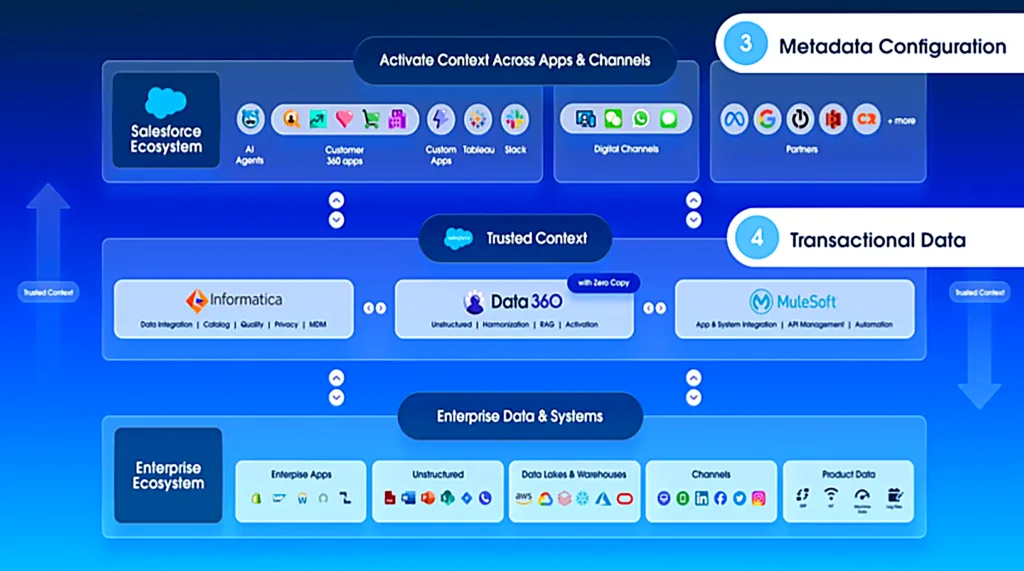
Layer 3: Metadata Configuration is the layer that explains the data. Which fields are actually populated? Which record types are active? What does this picklist value mean in this context? What flows run when this record is updated? Without this layer, an agent is guessing at the semantics of every field in your Org.
Layer 4: Transactional Data is what everyone talks about. The records, the customer history, the case details. Structured, queryable, available. This layer gets a lot of attention.
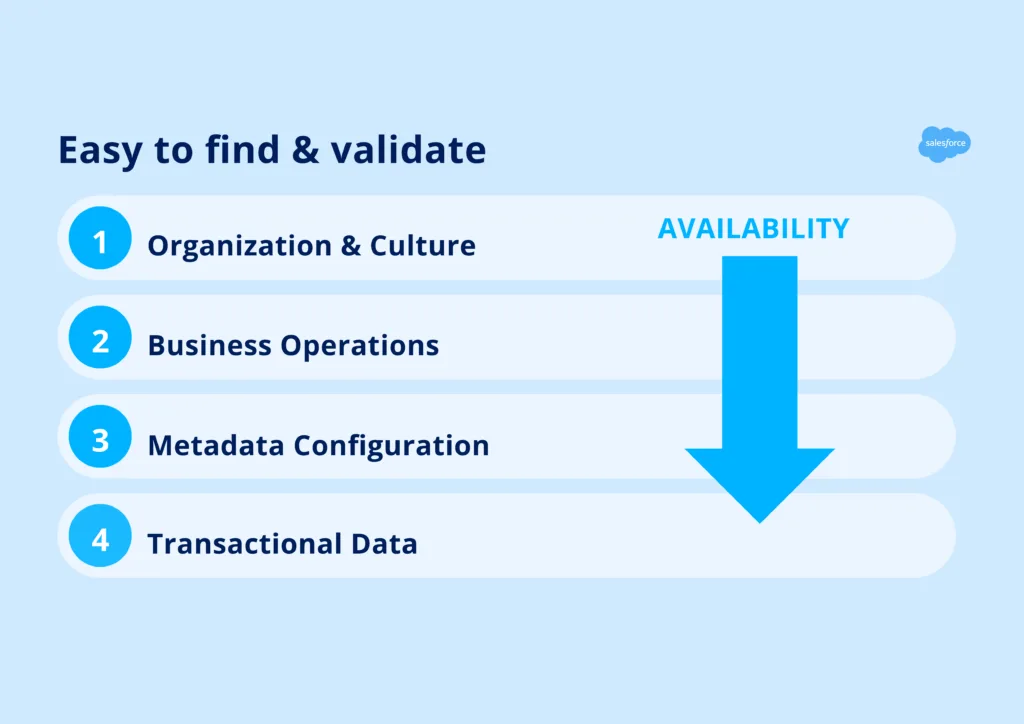
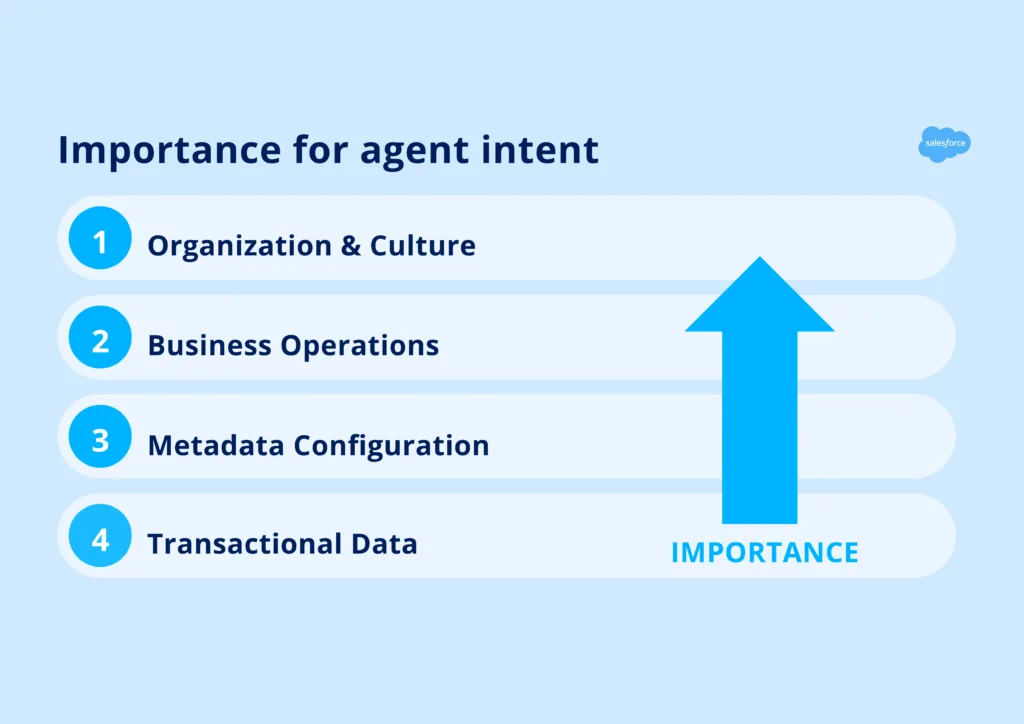
As you go up the stack, context becomes harder to find, less structured, and more important. The data layer is available and queryable. The culture layer barely exists as a document anywhere.
But the most underserved, and most critical for making agents work, sits at Layers 2 and 3. Business operations and metadata configuration. This is exactly where Elements.cloud lives.
The Context Gap That’s Killing Your Agent Deployment
Let me make this concrete.
At Elements.cloud, we’ve analysed nearly 1.5 billion metadata items across 100,000 Salesforce Orgs. What we find, consistently, is that Salesforce Orgs are extraordinarily complex; far more complex than anyone fully understands.
One Org we analysed had 257 record types on the Account object. 130 picklist fields. 5 million mappings between picklist values and record types. How many record types had live data? One.
Now imagine deploying an agent into that Org. Without metadata context, the agent has to treat all 257 record types as equally valid. It will query against fields that have never been populated. It will misinterpret picklist values that were created for a use case that was abandoned three years ago. It will follow process logic that was true in 2021 and has since been completely redesigned.
The agent isn’t wrong. It’s just missing the context it needs to be right.
This is the problem Elements.cloud was built to solve, not just for humans maintaining Salesforce, but now, critically, for the agents operating within it.
Elements.cloud: The Bridge Between Intent and Action
Think of it this way. An agent receives a task: resolve this Priority 1 support case for a Financial Services customer. That’s the intent. To execute, the agent needs to understand:
- Which Case record type applies to a Financial Services customer with a Priority 1 technical issue
- Which fields on that record type carry meaningful data versus which are legacy clutter
- Which flows and automations will fire when the case status changes
- What the standard resolution process looks like: the steps, the decision points, the escalation criteria
- How this process differs from the general support process, and why
- What “resolved” actually means in this context, according to this business
Without that knowledge, the agent is goal-seeking in the dark. It will find a path to closing the case. It won’t necessarily find the right path. Elements.cloud provides the metadata and process intelligence that connects the agent’s intent to the specific data, fields, flows, and processes required to act correctly.
This is what we mean by the missing link. Not more data. Not a better model. The context layer that explains what the data means and how the business uses it.
The Four Questions. And Why Elements.cloud Answers the Hardest Ones
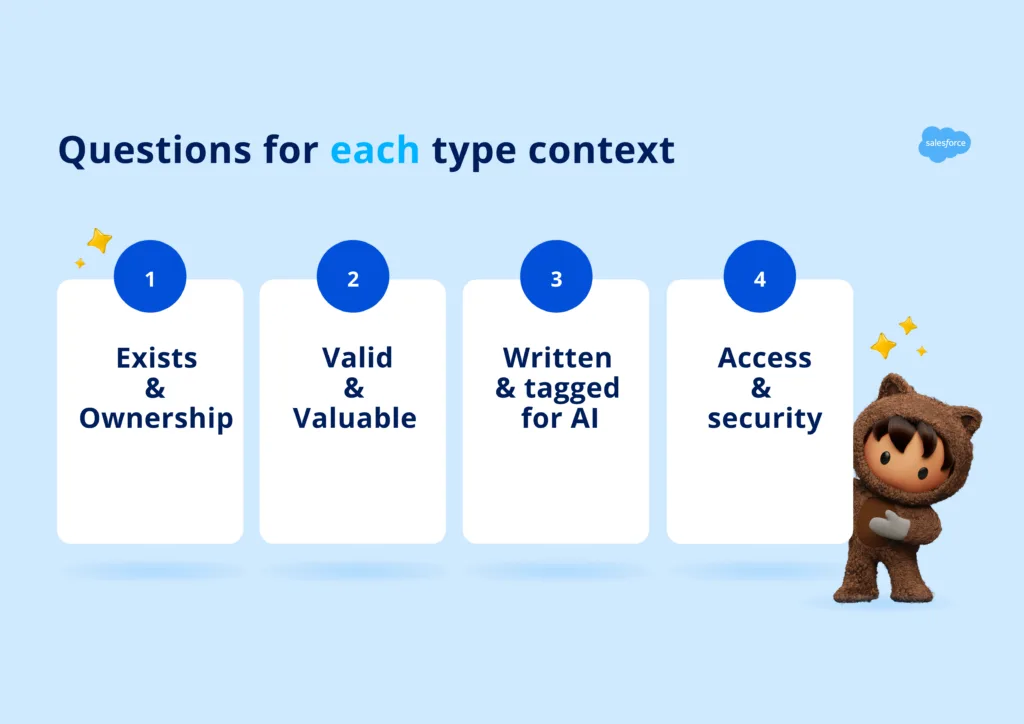
Before you can supply context to an agent, you have to audit it. Four questions apply at every layer:
1. Does it exist, and who owns it? For transactional data, usually yes. For metadata configuration and business process documentation, the honest answer in most Orgs is: partially, and ownership is murky. Elements.cloud’s Configuration Mining capability changes this: automated Salesforce documentation that would previously take months of manual work, done in minutes. Suddenly the metadata layer exists, is current, and has a clear home.
2. Is it valid and valuable? This is where most manual documentation fails. It was accurate when it was written. It’s out of date now. Elements.cloud’s Change Logs track every metadata change in the Org, so you always know what the configuration actually is today, not what someone documented six months ago. The context you supply to the agent reflects reality, not a historical snapshot.
3. Is it written and tagged for AI? Human-readable and AI-consumable are not the same thing. An agent can’t navigate a Confluence page the way a human analyst can. Elements.cloud structures Salesforce metadata and process documentation in a form that can be surfaced programmatically, by an MCP server, by a RAG pipeline, by any agent runtime that needs to ask: “what does this field mean, and which process uses it?” That’s the difference between context that exists and context that works.
4. Is access and security right? Elements.cloud’s Access & Compliance capabilities mean you can govern not just who has access to the Org, but which agents, in which contexts, can query which metadata and process documentation. Context governance, not just data governance.
Salesforce Goes Headless. The Stakes Just Got Higher
TDX 2026 made it clear: Salesforce is going headless. Agentforce is no longer just a feature inside the Salesforce UI. It’s an agent platform that can be deployed anywhere, through any interface, embedded in any workflow.
That’s a profound opportunity. It’s also a significant risk.
When an agent operates inside the Salesforce UI, the platform provides implicit scaffolding: labels, help text, validation rules, UI flows that guide the user (and implicitly, the agent) through the right path. Headless removes all of that. The agent is operating in a context-free environment. Everything it needs to know, you have to supply explicitly.
Headless Agentforce without a proper context layer is a power tool without a safety guard. The agent will execute. It will execute fast. Whether it executes correctly depends entirely on the quality of the context you’ve engineered.
Elements.cloud is the safety guard. The metadata intelligence layer. The process knowledge foundation that ensures headless agents operate with the same accuracy and alignment as the most experienced person on your team.
The MCP Connection: Elements.cloud as Runtime Context
Here’s where this becomes architecturally important.
The emerging pattern for enterprise agent context is MCP: the Model Context Protocol. Instead of trying to stuff all necessary context into a single enormous system prompt (expensive, inefficient, and stale the moment anything changes), you wire up MCP servers that the agent can query at runtime, pulling exactly the context it needs for the task at hand.
Each of the four context layers maps naturally to an MCP server:
- Layer 1 (Org & Culture) → Open Brain or equivalent institutional knowledge store
- Layer 2 (Business Operations) → Elements.cloud MCP
- Layer 3 (Metadata Configuration) → Elements.cloud MCP
- Layer 4 (Transactional Data) → Salesforce Data Cloud MCP, ERP connectors
Elements.cloud doesn’t just sit at one layer: it bridges Layers 2 and 3, which is exactly where the intent-to-action gap lives.
An agent working a case can query the Elements.cloud MCP server to ask: “What is the correct record type for this case type? Which fields are relevant? What process should I follow? What are the decision points and escalation criteria?” The MCP server returns precisely that context. Not the entire Org documentation, but the specific, current, structured knowledge the agent needs for this task, right now.
This is context in context. The right metadata and process intelligence, delivered dynamically, at the moment of need. That’s not a future vision. That’s what Elements.cloud is built to do.
What This Means for Your Agent Deployment
If you are deploying Agentforce (or any AI agent that operates against Salesforce data) you need to answer an honest question: does your agent actually understand your Org? Not “does it have API access.” Does it understand it?
- Does it know which fields carry real data and which are legacy clutter?
- Does it know which record types are active and which were abandoned?
- Does it know which process applies to which type of transaction?
- Does it know the decision logic at each step, and what the edge cases are?
- Does it know when the configuration changed, and therefore when any cached context became stale?
If the answer to any of those questions is “not really,” you have a context gap. And that context gap will manifest as agent errors; not dramatic failures, but subtle wrong turns that compound over time and erode trust in the system.
Elements.cloud closes that gap. Configuration Mining gives you the metadata documentation. Impact Analysis shows how everything connects. Change Logs keep the context current. Process documentation structures the operational knowledge in AI-consumable form. And an MCP integration delivers all of it to the agent at runtime, dynamically, without bloating the context window with information that isn’t relevant to the current task.
The Bottom Line
When Reed Hastings wrote No Rules Rules in 2020, he wasn’t writing about AI agents. He was writing about employees. But the principle translates perfectly: “When they do something dumb, don’t blame them. Instead ask yourself what context you failed to set.”
Your agents will do dumb things if you haven’t given them the context they need. Not because the model is bad. Not because Agentforce doesn’t work. Because the metadata layer and the process layer (the layers that connect intent to action) haven’t been engineered properly.
Elements.cloud is the platform that makes that engineering possible. Not in months of manual documentation. In minutes. Your Salesforce went from a Ford Focus to an Aston Martin GTE race car. Now it needs a full race team with the skills and tools to make it perform.
Elements.cloud is the toolset. Context engineering is the skill. Your agents are waiting
Elements.cloud: A Change Intelligence platform for Salesforce
Configuration Mining, Impact Analysis, Process Documentation, and Access & Compliance, provide everything you need to understand your Org deeply enough to deploy AI agents that actually work.